

Decoding CVC words plays an important role in kindergarten reading instruction. However, with so many instructional approaches and activity ideas available, it can be challenging to decide how to introduce and practice them effectively. CVC words are often the first time students begin blending individual sounds into real words, making this an exciting (and essential) step in early literacy development.
In this post, I’m sharing simple, classroom-tested ways to teach and practice CVC words in kindergarten, along with practical activity ideas that can be used during whole group instruction, small groups, or independent work.
What Are CVC Words?
CVC words are words made up of a consonant-vowel-consonant pattern. Some common examples include cap, pet, and bin. These short words are developmentally appropriate for kindergarten because they follow predictable sound patterns and provide good blending practice.
When students work with CVC words, they practice:
- Hearing individual sounds in a word
- Blending sounds together
- Connecting sounds and their corresponding letters
All of these skills are essential for early reading success. As students become comfortable blending CVC words, they’re better prepared to move onto reading simple sentences, as well as writing CVC words and simple sentences.
When to Introduce CVC Words
Most kindergarten students are ready for CVC words after they:
- Can produce at least 7 or 8 letter sounds, including a short vowel (typically /a/)
- Have practiced oral blending (hearing phonemes separately and blending them to say the word)
- Can track print from left to right
CVC words aren’t something that students master in a single unit. Instead, blending practice instruction happens gradually, with lots of repeated practice throughout the year.
Where to Start Your CVC Word Instruction
When introducing CVC words in kindergarten, it’s helpful to be intentional about which words you start with.
Many teachers choose to start with short a CVC words, such as rat, map, and fan. Short a is usually easy for students to hear and say clearly, making it a natural starting point for early decoding practice.
It’s also helpful to choose words that include a continuous sound at the beginning. Continuous sounds, like m, r, s, f, and n, can be held, making them easier for students to blend together. For example, words like mat, ram, or sag allow students to smoothly connect each sound as they read.
Starting with short ‘a’ and using continuous sounds helps reduce frustration and supports more successful early reading experiences. As students grow more confident, you can gradually introduce other sounds.
Hands-On CVC Word Activities
Here are a few CVC word activities that students will enjoy, starting from basic and introductory activities and ending with more independent activities!
- Sound Stretching: Have students say each sound slowly and stretch it out
- Build the Word: Use magnetic letters and letter mats to build words

- Tap and Blend: Tap each sound on fingers, then blend (this linking activity has dots to help with tracking)

- Say It, Build It, Write It: Read the word, build it with letters, then write it
- CVC Read and Spot: Students will read each CVC word, locate the matching picture, and color it.

These activities work well for whole group instruction, as well as for literacy centers and small groups. Be sure to model the activities first before adding them to literacy centers.
Using Decodable Texts to Practice CVC Words in Kindergarten
Once students are comfortable reading CVC words in isolation, it’s important to give them opportunities to read those words in context. This is where short decodable texts can be especially helpful.
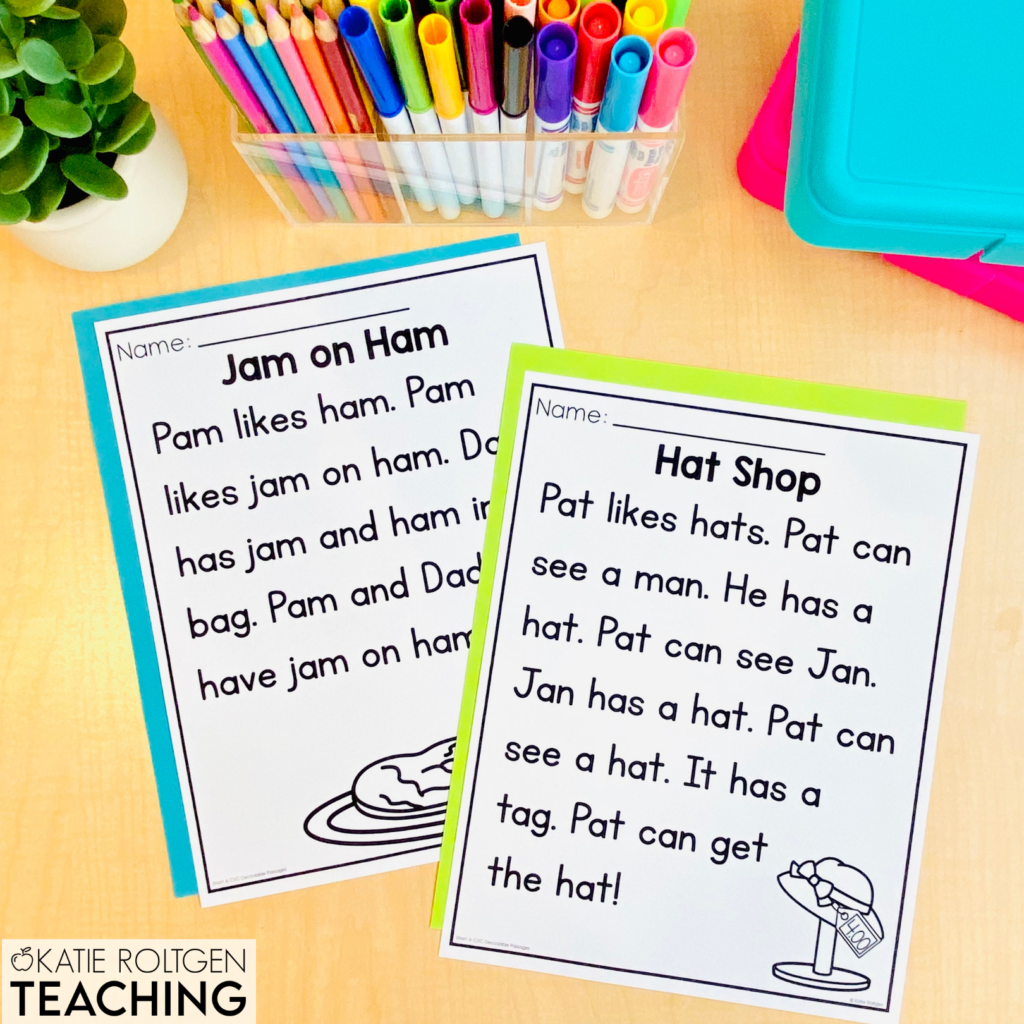
Decodable passages and readers allow students to apply their CVC word knowledge in meaningful text, which builds confidence and reinforces phonics skills. Resources like CVC decodable passages and readers support this type of structured practice at students’ developmental levels.

Putting It All Together: CVC Words in Kindergarten
CVC words play an important role in kindergarten phonics instruction, but CVC word activities don’t need to be complicated. With consistent routines, hands-on activities, and opportunities to read CVC words in connected text, students can build strong early reading skills with confidence.
You Might Also Like:
The Importance of Decodable Passages in Kindergarten
Letter Recognition Games for Kindergarten


